
Best Free Websites, Apps and Tools to Learn Japanese 2025
There are many websites for learning Japanese. Today, we would like to share some websites, apps, and tools that work as great resources for both self-study and for students of the Culture and Language Academy of Yamanashi. Here is a list of the Websites, Apps and Tools we would recommend today:
Renshuu - self-study website and app
WATANOC - free online magazine with easy Japanese
NHK News Web Easy - News in easy Japanese
NihongoDera - Japanese-English dictionary website with lots of tools
JISHO - a dictionary website and an iOS app with Flashcards
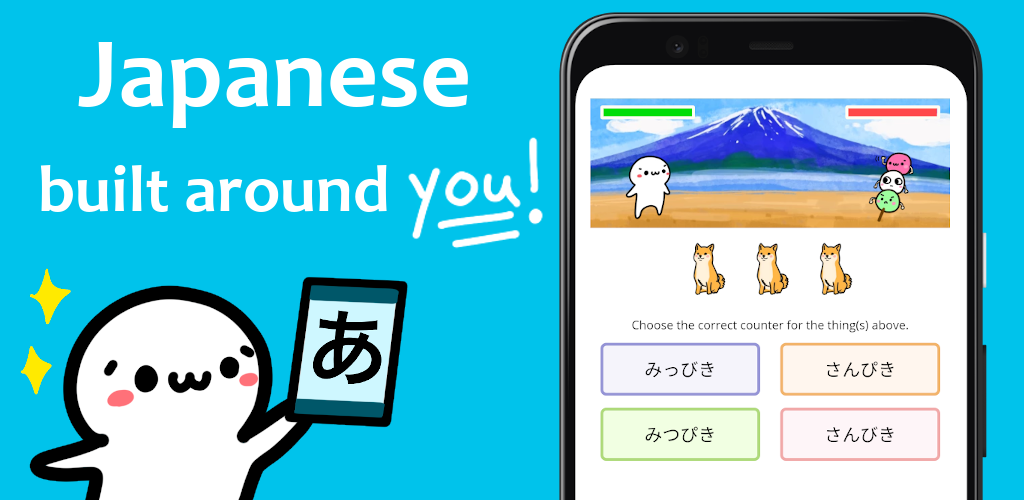
Kanji Dojo - Smartphone game for studying kanji and battling with friends
MIgii JLPT - an app for training for the JLPT exam
Anki - flashcard program
Yomitan - a browser extension that works as a pop-up dictionary.
Yomikiri - browser extension for Safari (works on iPhone)
Disclaimer! This is not a ranking from best to worst! Each website, app, or tool has its own strengths and purpose. Choose the ones that make your learning more fun and effective!
Let's dive into it more detailed:
Renshuu
renshuu.org - This website (also available as an app for both iOS and Android) is perfect for self-study as well as a daily learning assistant in Japanese language classes. It offers vocabulary lists, games, and flashcards with translations and images that help you remember words. There are also grammar lessons presented in slide format with step-by-step explanations for easy understanding. Both the site and the app include a background game called “Garden”, where you can grow flowers with the points you earn from completing lessons and studying words. You can also add friends on the app to track each other’s progress and keep your motivation up with some healthy competition!
In fact, there is so much on this platform—games, puzzles, a lively community, and more—that anyone interested in learning Japanese should give it a try at least once.
WATANOC
https://watanoc.com/ - A reading library with pictures! The texts are categorized by JLPT level, so you can gradually expand your vocabulary according to your current ability, while also learning more about Japanese culture and the world. You can hover over words or kanji to see readings, translations, and explanations of vocabulary and grammar. The site includes plenty of photos to help readers guess the meaning without relying on translations and remember words on an intuitive level. There’s also an audio reading option so you can listen to the text as you read.


NHK News Web Easy – A site with Japanese news written in simple, easy-to-understand language. It uses basic kanji with furigana (which can be turned off if you want) and also offers audio versions of the articles. NEWS WEB EASY publishes simplified Japanese news stories designed for international residents, learners of Japanese, and school-age children.

NihongoDera - A dictionary site that includes many useful features. It offers “Word of the Day” and “Kanji of the Day,” which are great motivators for expanding your vocabulary. The site also includes converters for Hiragana, Katakana, and Romaji. But the best tool is the Text Analyzer: you can paste up to 10,000 characters of text, and the site will break it down for you—showing each kanji, with explanations and translations of every word when you hover over it. This makes it a fantastic tool for learning new topic-specific vocabulary.

JISHO
Jisho - A dictionary website that also has an iOS app. You can look up unfamiliar words or kanji, check pronunciation, listen to it, and even learn the correct stroke order. The dictionary lets you study kanji individually, in compounds, or by radicals. Each word entry also includes example sentences to show how the word is used in context. In the app, you’ll also find flashcard sets organized by JLPT levels, school curriculum, or word categories.
Kanji Dojo
Kanji Dojo - An app for learning kanji—or better yet, for reviewing kanji you’ve already studied. It has different functions, but in our opinion, its best feature is helping you practice writing kanji. The app checks your stroke order and gives hints if you forget how a kanji is written. You can also battle other players online—either with random users or friends—making study fun and motivating through competition. The example sentences provide immediate access to the meaning of individual kanji, words, phrases, or full sentences.
MIgii JLPT
Migii JLPT - an app specifically designed for JLPT preparation. It has a lot of tests in JLPT style, and offers both free and paid practice tests. When you highlight words or sentences, the app provides translations, and if you make a mistake, it gives explanations. It’s a perfect tool for training for the exam.

Anki is a powerful flashcard program that uses a spaced repetition system (SRS) to help you memorize vocabulary, kanji, and grammar more effectively. You can create your own decks or download shared decks made by other learners. Anki is especially popular among language learners because it allows you to review information just before you are likely to forget it, making your study time much more efficient.
💡 Important to know:
Anki is free for Windows, Mac, and Android.
On iOS (iPhone/iPad), the app is paid (about 4000yen or 25 USD on the App Store). This purchase helps support further development of the software.
📖 Installation & Beginner’s Guide:
Yomitan
Yomitan is a browser extension (for Chrome, Firefox, Edge) that works as a pop-up dictionary for Japanese. When you hover over words on a webpage, it shows you the meaning, reading, pitch accent, and even lets you create Anki flashcards with one click. You must download and import the dictionaries you wish to use in order to enable Yomitan definition lookups.
There are several free dictionaries available for Yomitan, some of them with glossaries available in different languages. Check out their "Getting started" guide!

Yomikiri

Yomikiri is an iOS mobile app. Works almost the same as Yomitan for the PC browser, but for Safari. The app uses the JMneDict database, which includes over 74,000 entries, and provides grammar references with links to Tofugu explanations. Check out the official guide to get started with installation and dictionary setup!
Thank you for reading this blog post. We hope you found something useful for your Japanese self-studies!


Comments